For as long as I can remember as women we have been trained to want…no NEED new clothes every time the season changes. It’s lead to a rather problematic fast fashion industry that churns out new styles nearly weekly to meet the consumer appetite. So to buy new or not to buy new? I deal with this struggle daily, but I’m learning there’s no need to feel guilty every time you buy something new. Here at Bloom & Spark it’s my mission to explore little ways I can be most sustainably minded while still living my life…and buying cute new clothes occasionally.
I’ve found that the simple habit of shifting WHERE I purchase my clothes can reduce some of the negative impact that certain fast fashion brands have on the environment. Focusing on brands that have a sustainable supply chain with ethical, and eco conscious practices is one simple way I can be more eco friendly in my day to day life.
So I’ve looked at some of my most beloved sustainable clothing brands to pull my favorite FALL FASHION items! I do the searching so you don’t have to. I hope this can be a simple place where you can find a few beautiful pieces for fall, without spending hours researching the sustainability practices behind the brands. I’ve done all that for you!
As always, some of these items contain affiliate links which allow me to make a small commission from products I share here, but you don’t pay any extra (this helps tremendously, as most of these posts are thoroughly researched for many hours and I have a large golden retriever to feed). It’s just a way for brands to say “thanks!” when bloggers share their products. I only share products I use myself, plan to use, or brands that are aligned with my values. To learn how this works see my affiliate disclaimer.
Fall Fashion…but make it sustainable
“Mom” Jeans or “Mother Earth” Jeans?
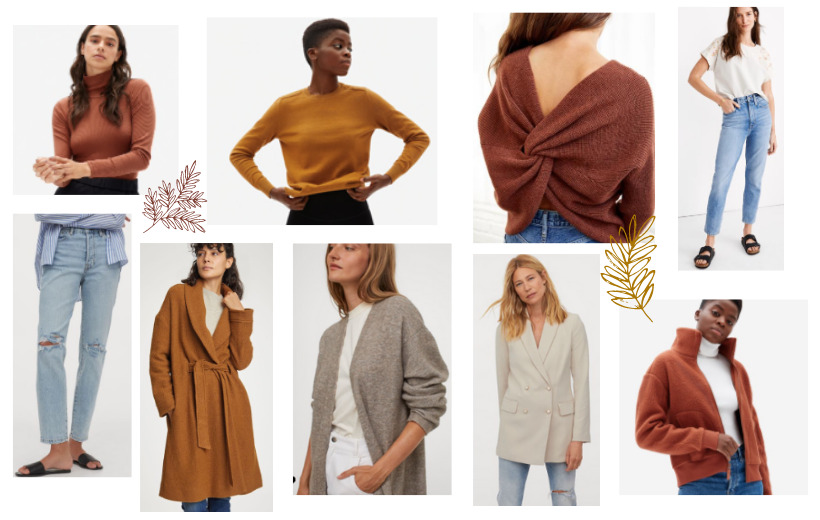
Pre-covid I tried on these “momjeans” from Madewell and I heard a chorus of angels singing. Seriously, I’ve never worn jeans that still felt comfortable to bend and sit in. My husband was none too impressed with the momjean look so I decided against them at the time…but I’ve thought about these jeans ever since. Now that we’re all mostly working from home it’s important to find daily work “uniforms” that are both comfy, but also not sweats. I am definitely ordering myself a pair of these so I feel like I’ve actually gotten dressed, husband be damned. These similar pairs here and here are from H&M’s Conscious line.
Merlot & Mustard
I’m really feeling these colors this fall, what can I say. A great fall staple is this turtleneck body suit from Everlane in “dark spice” yes that’s the color and it’s stunning! This gorgeous mustard crewneck from Everlane is made with organic cotton *throws confetti.* I’ve never worn a sweater knotted in the back like this one from Amour Vert but it’s just what “fall vibes” are made of (also their packaging is compostable…I know right?). Take a look at all my favorites:
Stay Warm
I could make some quip about global warming *sheads a tear*, but instead I’m just gonna leave these gorgeous (and eco-friendly) coats here. Another winner from Everlane (can they do any wrong?) with their ReNew Teddy Bomber is made of 100% recycled polyester. I’m also really feeling this double breasted blazer from H&M’s conscious line.
What makes these items “sustainable”
We all know that ultimately the most sustainable clothes are the ones already in existance. Repairing and rewearing items that you already own, or purchasing through consignment and thrift stores are the best ways to do that. However, for making new purchases I look into the companies practices to see how they make the clothes, and how far the clothes have to travel to get to you. I will break down some of the ways these items are sustainable with a few examples:
The ReNew Teddy Bomber from Everlane is made from 100% recycled polyester. Only the buttons and trim are not made from recycled materials because those pieces can’t currently be sourced in recycled materials. Everlane is one of the most transparent brands which for me speaks volumes to their ethics and values. They break down the true cost of this (and every) item from the materials and hardware, to the labor and transport. They also share honestly about the factory where it is made and workers who put it together.
This sweater from Everlane is made from organic cotton and is certified organic from seed to shirt. The Global Organic Textile Standard (GOTS) certification takes over a year to account for every step of production from the processing of certified organic fiber into yarn, to the dyehouses, mills, factories, and printers. Since it’s from Everlane we also know exactly where it comes from.
Truthfully H&M is not the first place I go when I think of “sustainable clothing.” However I applaud their efforts to move toward a more sustainable model and when I see companies doing that I want to support it. You can read about their sustainable initiatives here. These jeans from H&M’s Conscious collection are made from partly recycles materials. How much you ask? Well, it’s not detailed on the website, which is an area I think they could use a bit more transparency. But at this price point I am happy to support these more accessible brands that are moving in the right directions.
Amour Vert lays out their sustainability practices on their website which you can see here. Three ways they are sustainable include 1) making their pieces in limited quantities to reduce waste 2) producing a majority of their pieces in California which reduces it’s carbon footprint for those of us purchasing in the U.S. and 3) using renewable and recycled materials such as recycled wool, sustainably grown hemp, and TENCEL made from sustainably farmed eucalyptus trees. *BONUS* their packaging is all compostable!
In this eco friendly gift guide for kids I've searched through all of my favorite brands for the perfect items. I know as busy parents during the holiday season you don't have time to do all the research on the toys you get for your kids, but you also don't want more...
Moving toward a cleaner skin and makeup routine is something that is important, but definitely time consuming. This year I've searched through all of my favorite clean beauty brands for the perfect gift guide items. The clean beauty gift guide is perfect for your best...
I called this one Sustainable Gift Guide: Pretty Little Things because what gal doesn't want some pretty little things to open this holiday season. These ideas are perfect for your best friend, sister, mom, wife, or even yourself! I've searched through all of my...
Hey friends, in these uncertain times I’ve been craving extra sources of comfort from certain foods (I am a cookie queen, no judgement please) to my daily self care and especially what I’m wearing. If you’re like me you’ve probably been scouring the internet for a new pair of comfy joggers, or a cute matching pajama set. It’s safe to say that loungewear is having a moment. So I’ve compiled some of my favorite sustainable and ethical loungewear to help you quarantine in style.
I’m really trying to be more intentional with how I spend money these days. Not soley from a financially responsible point of view, but from an ethically, socially, and sustainably conscious point of view.
If I’m spending my precious dollars I want it to go towards companies I wish to see survive the economic meltdown. Remember, we vote with our dollars, so now more than ever it’s important to put our money where our values are.
One of the best ways we can be spending our stimulus checks (aside from paying bills and feeding your family or course) is by putting it into brands that uphold strong values of sustainability and ethical treatment of workers and the planet. Lucky for you I’ve done the hours of research so you don’t have to. I’ve searched through brands that maintain high standards of conservation and and fair treatment of everyone across the supply chain, for the cutest sustainable and ethical loungewear I could find.
Here are some of my favorite sustainable and ethical loungewear picks for quarantining in style, from brands that are doing good for the planet and humanity:
Tops
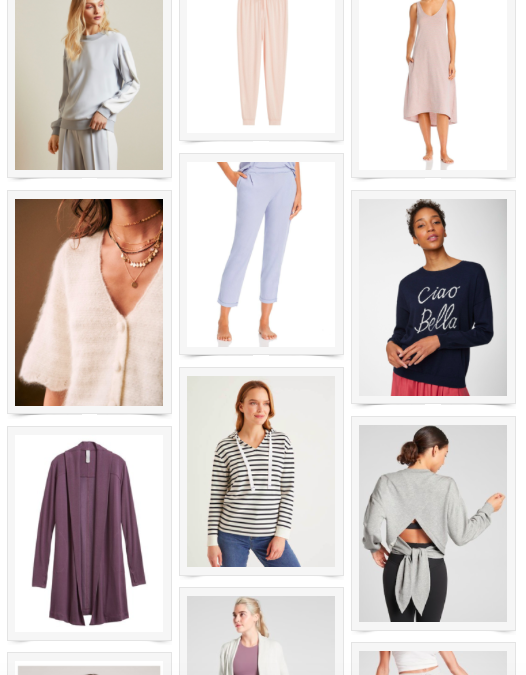
One of my all time favorite purchases is the Athleta Wrap Sweater. I bought it last winter and it was basically my uniform. It is the softest material I’ve ever felt! For a cute twist on a basic sweatshirt the Yoga Tie Back top from Athleta will definitely elevate your style while still being comfy. If you know me well, you know that blue and white stripes are sort of my thing. If I were a cartoon character that only got one outfit to wear for the rest of my life, it would be this hoodie from Boden. I love Boden because they are dedicated to sustianability from the macro, like using sustainably sourced cotton in their garments, to the micro, by repurposing rainwater to flush all the toilets in their warehouse (I mean, that’s dedication)! The People Tree Laurel Top is made from 100% organic cotton. People Tree is committed to multiple sustainability and fair trade values, that I completely support.
Bottoms
For bottoms I’m all about the jogger, and they MUST be super soft. The cotton in the Cuyana Pima Tapered Pant and their Wide Leg Pantis grown, spun, and made into finished garments all in Peru, reducing it’s carbon footprint. These Natural Skin Sleep Pants are made from organic cotton and are suuuuper soft! Athleta is a certified B Corp which means they use their business as a source for good. They are extremely transparent on their website about how they are maintaining high sustainability standards. Their Farallon Jogger is on its way to me as I type this!
Pajamas
I’ve never been a fan of nightgowns. I feel like I have to be a little girl or an old lady to pull it off, but this nightgown from Natural Skin...woah. I might be changing my ways. Even if you never wear this to sleep in, it’s such a sweet and comfy around the house dress that makes you feel like you made an effort (but really you didn’t). The Matching Sleep Sets from Pact are perfect for the warmer months. I don’t know what it is about matching pajamas but I feel like a sophisticated lady when I wear them (but I guess I would feel sophisticated in anything other than my college teeshirt and pajama pants with holes my dog chewed). BTW Pact has super affordable products that are made from organic cotton, are fair trade certified, and maintain a Sustainable and Ethical Style Guarantee.
Note: This post may contain affiliate links which allow me to make a small commission from products you purchase through my links. To learn how this works see my affiliate disclaimer.
If you’re like me, and so many others these days, you’ve probably been wanting to shop more sustainably. You might have read my post on fast fashion where I shared some pretty surprising facts that might make you think twice before going to a Forever 21 or H&M again.
The rise and demise of fast fashion is a complicated story, but needless to say we are slowly turnig toward the “Sustainable Fashion Movement” focusing on brands with ethical production processes, using sustainable materials, and making a more positive impact on the planet.
It can be overwhelming to know where to shop when you want to stick to your sustainable values. So I’ve compiled a list of some brands you’ll definitely want to check out as you transition from your fast fashion choices from your college days, into the more stylishly sustainable woman you are.
Based in: California, USA
Philosophy: Transparent supply chain, ethical production of garment
What you can expect: I love that unlike most clothing brands out there, Everlane is all about transparency. They focus on using factories (usually the ones that produce your most coveted luxury labels) that ensure and maintain ethical production practices every step of the way. They share with full transparency what their products cost to make, where the garment was made, and information about the standards and working environment of the people who made that garment. It’s eyeopening to know the true cost of an item and the production stories behind each piece of clothing. Their minimal, modern aesthetic makes them timeless, which is also incredibly sustainable, because you won’t be throwing it out next in a few years.
Philosophy: Ethical production process, recycled materials
What you can expect:Outdoor Voices make a variety of clothing for all of life’s active moments, across seasons and activities. From nature hikes, to spin class, on yoga mat, and long dog walks. Outdoor Voices sources their materials with sustainability in mind, such as recycled polyester made from water bottle and their sustainably-sourced merino wool. They prioritize ethical practices and working conditions when selecting their U.S. used and overseas factories.
What you can expect:From their button-downs to their linen tees, Tradlands shirts are a staple in any capsule wardrobe. Tradlands creates menswear-inspired staples for women with a relentless emphasis on fit, details, and quality. Their rigorous standards ensure that each shirt you purchase is top-notch quality, and has been ethically and sustainably made. They strive to use 98% of their materials and recycle any remnants in order to keep their waste to a minimum.
Philosophy:Ethical production, Fair Labor Association, 70% sustainable materials, Green Certified
What you can expect:It’s rare to find fashion brands that are both ethical and sustainable, but Alternative Apparel ranks well for both these categories. Alternative respects and values the rights of workers in all countries and believe in the right to fair and safe workplace conditions. Their factories operate in accordance with the Fair Labor Association Workplace Code of Conduct and they make over 70% of their garments with sustainable materials and processes. Alternative is a certified Green Business in LA. We love their modern and casual basics for men and women.
Philosophy:Ethical & small batch production, sustainable fabrics
What you can expect:At Petite Studio, it takes an average of 20 hours to produce a single garment. That’s because the NYC-based brand is passionate about creating capsule wardrobe items and small-batch staples. This petite-focused clothing collection is carefully crafted in an ethical factory, located in Jiangshan, China (the founder’s hometown). Employees work 40-hour per week (with hour-long lunch breaks), receive health care and vacation time, and are even obligated to take a 30-minute nap break every shift.
What you can expect: Krochet Kids Intl. is great for affordable, on-trend clothing. Most of all they are appreciated for the incredible impact they have on the communities where their artisans live and work. This nonprofit social impact brand empowers their artisans in Uganda and Peru not only through fair wages, but also through education and mentoring programs.
Philosophy:Slow fashion brand, supports craftspeople, give-back program
What you can expect:Cuyana is an essential brand for the modern woman seeking to build her wardrobe on the “fewer, better” principle—so if you’re looking for elegant and long-lasting capsule pieces, Cuyana has what you’re looking for. This global fashion brand creates each piece with integrity and kindness from the highest-quality materials in Europe, South America and the United States.
Yes, you read that correctly. The rise and demise of fast fashion is upon us.
But let’s take a walk down memory lane shall we? Do you remember back in high school the thrill of shopping at stores like Forever 21 and getting the latest trends for just a few dollars? It felt pretty amazing to be able to spend your babysitting money on a cute pair of ripped low rise jeans so Brad in 5th period would hopefully notice you this year ’cause your braces finally came off (!!!). But what we didn’t realize was the real cost of cheap, fast fashion.
Fast Fashion Defined
“An approach to the design, creation, and marketing of clothing fashions that emphasizes making fashion trends quickly and cheaply available to consumers.” -Merriam-Webster
“Fast fashion utilizes trend replication, rapid production, and low quality materials in order to bring inexpensive styles to the public. Unfortunately, this results in harmful impacts to the environment, human well-being, and ultimately our wallets.” -The Good Trade
“Fast fashion” is a term used by fashion retailers to describe inexpensive designs that move quickly from the catwalk to stores to meet new trends. As a result of this trend, the tradition of introducing new fashion lines on a seasonal basis is being challenged. Today, it is not uncommon for fast-fashion retailers to introduce new products multiple times in a single week to stay on-trend.” -Investopedia
How Fast Fashion Got Started
Only until recently the fashion industry had four seasons (winter, spring, summer, and fall). Each season pieces were carefully designed and brought to market. (For a much more thorough history than I can give here, check out this article from Fashionista.com)
In the 1960s, as young people began to set and follow new trends, the industry had to respond by producing newer, trendier, and cheaper clothing.
This model slowly picked up speed until the fast fashion retail market exploded in the 90’s and early 00’s.
Somewhere in this time the consumer mentality shifted from owning a few pieces of quality, hand crafted garments, to weekly shopping trips to the mall and owning more clothes at cheaper prices.
To support our fashion fix, companies had to outsource labor to developing companies, shift to cheaper fabrics and dyes, and forgo quality in favor of production speed.
The Environmental and Ethical Impact
I am so sorry to be the bearer of bad news (I wanted to cry when doing research for this post) but it’s best to be an educated consumer so here are the facts.
Toxicity: When clothing is made cheaply it’s often made withtoxic chemicals, dyes, and synthetic fabrics which seep into the water suppliesin the countries where the clothing is made and at home when the clothing is washed. An estimated 20% of global industrial water pollution comes from the treatment and dyeing of textiles.
Pollution:In addition to the making of your clothes, when you wash clothes made from cheap synthetic fabrics microfibers are leaked into the water supply, causing more pollution. Microfibers are microscopic pieces of plastic, just like the microbeads that were banned from those old acne scrub products and toothpastes (I know, we all thought those were so cool at the time).
Unethical Labor: The health of every garment factory worker is often jeopardized due to long hours, lack of resources, exposure to harmful chemicals, and even physical abusein some cases. The women and men (and sometimes children) who make your new spring frock are often underpaid, underfed, and pushed to their limits because there are often few other options. I don’t know about you, but I personally do not want to contribute to that if I can help it.
Waste: The easy-come-easy-go nature of fast fashion means we don’t think twice before tossing a garment that has lost its shape, faded, shrunk, or just gone out of style. According to Rubicon over 11 million tons of recyclable clothing, shoes, and textiles make their way into landfills each year.
The Demise of Fast Fashion
In recent years the once unstoppable growth of the fast fashion industry has taken a turn. Business Insider reported that H&M recently announced they would be closing 160 stores worldwide after accumulating over $4 billion dollars worth of unsold clothing that was piling up, causing them to take a major financial hit.
There is also a phenomenal articles about this in the New York Times if you want to dive deeper down this rabbit hole.
We don’t need to build our end-of-the-world-bunkers just yet. With the imminent demise of fast fashion comes the rise of sustainable fashion. This video from Teen Vogue (of all places) hits the nail on the head.
Like it? Share it! C’mon, you know you’re gonna be on Pinterest today anyway.
I’m really happy about sustainable fashion being a thing now. Anyone else? It’s been over 10 years since I first started becoming aware of our impact on the planet, and in that time we have seen catastrophic destruction to ecosystems and parts of the world as a result of climate change (as I type this the Amazon is on fire *sheds a tear*), and unfortunately it’s not slowing down anytime soon.
Perhaps for you it feels like nothing you do will make a difference, but I’d rather live by my values, even if it feels like a drop in the bucket.
If you are like me and care even the slightest about the impact your lifestyle has on the planet then you probably desire to make some changes to your lifestyle.
The big question is HOW.
I believe in simple swaps and ways to make a difference without going totally off the grid. As a whole we are creatures of habit and naturally resist changing how we shop for our favorite products, eat our favorite foods, and discard the associated waste. Fortunately I believe we are going in the right direction and soon it will become easier and easier to make smarter choices.
One thing I’ve been doing lately is shifting from consuming Fast Fashion to focusing more on Sustainable Fashion.
What is Fast Fashion?
Fast Fashion refers to the trendy, of-the-moment designs at a cheap price point that move quickly from the catwalk into your closet. They are often replaced by newer designs within a season or two or fall apart after several washes due to their low quality production. The production, consumption, and disposal of Fast Fashion is alarmingly harmful to our planet. I talk all about the facts of fast fashion in my next post.
What is Sustainable Fashion?
Sustainable Fashion is a movement towards creating a global shift in fashion production and consumption that has less of a negative impact on the environment.
This is done on many levels. First, at the production level, clothing companies are now producing textiles with less chemicals and toxic dyes, thereby releasing fewer toxins into the water supply. Factories are also now considering the ethical treatment of their workers, ensuring they have a safe environment in which to work, as well as the basic human rights of factory workers.
Next, at the consumption level, the sustainable fashion movement aims to urge buyers to become more mindful about the clothing they are purchasing. As educated consumers who care about the environment we must know what type of an impact we are making through where we spend our dollars. By shifting away from shopping at fast fashion retailers and look toward high quality, ethical brands we can begin to tip the scales toward sustainable fashion becoming a major industry.
Lastly, sustainable fashion hopes to reduce clothing waste at the end of a garment’s lifecycle. Think of all the clothes you’ve ever worn in your life. Now imagine them all in a landfill. That’s where they go, unfortunately. By creating more opportunities for textiles to be recycled, and changing our habits with regard to our habit for flippant consuming and discarding of clothing after a few wears, we can hopefully reduce the amount of waste we are creating.
I also want to note that nothing is more sustainable than reusing or buying second hand.
Why is it the future?
More than 50% of consumers plan to switch brands in the future if another brand acts more environmentally and socially friendly than their preferred one
75% of consumers view sustainability as extremely or very important.
More than a third of consumers report they have already switched from their preferred brand to another because it credibly stands for positive environmental and/or social practices.
We’ve been seeing this shift in the food industry as we focus on local food, demanding organic, and bringing mindfulness back to grocery shopping. Similarly the fashion industry is beginning to see the same shifts in the values and desires of customers.
We’re not just demanding more products anymore like the generations before us. We are demanding transparency and choose brands that align with our values, not our checkbook. Sustainable and ethical fashion is not a small niche market anymore.
It’s up to us to become educated and mindful consumers. Are you going to support ethical and sustainable fashion brands?
The answer is yours. Share your thoughts with us in the comments below!
Hi, I’m Caroline! Welcome to Bloom & Spark, an intuition led, wellness based lifestyle blog. With a focus on mindfulness and sustainability this space is for creating authentic engagement in what it means to live well. Here you will find insights and lifestyle tips for yoga & meditation, simple recipes, purposeful living, and realistic sustainability. Manifesting Generator, Gemini,